
By Clint Von Gundy
Reader, Harvey Dent was right: “You either die a hero, or live long enough to see yourself become the villain.”
I was not a great fan of Christopher Nolan’s take on Batman (no one seems to be having any fun), but after fifteen years in gifted education, I had to take a moment to reflect on the declaration of the man who eventually becomes Two-Face, and on fun.
Anybody who knows me even a little knows that I always took great pleasure in berating the “G/T Project Lady.” For many of my professional years on this planet, I railed against sugar-cube pyramids (reducing an ancient and grand empire to something you can find in the pantry!) and spaghetti-and-marshmallow towers (not exactly a peanut butter and chocolate romance), the things that, in gifted and talented education, used to pass for a curriculum. I complained about the endless parade of loosely connected activities that were labeled “gifted” simply because they were hands-on, creative, or some person’s idea of fun. The G/T Project Lady, in my imagination, was always the person from whom I’d taken over, a woman in a colorful broom skirt, with Ms. Frizzle vibes, who left behind bags full of glitter, enough loose buttons and beads to buy Manhattan Island, a metric ton of popsicle sticks, and thousands of pages worth of antiquated grid logics in a filing cabinet that was rusted beyond the help of gods or men. She was the person I had to clean up after, sometimes with an actual broom (so much glitter, y’all).
Being the new G/T teacher after the “G/T Project Lady” retired meant a few weeks’ worth of digging down into the fossil record of ancient ‘“enrichment activities,” and a few more of getting the gifted kids now in my charge to realize that G/T is fun, yes, but that isn’t the point of G/T: “We’re here to work, kiddos. I don’t believe in fluff.”
This attitude, this philosophy, served me well for a very long time. It worked right up until the middle of March of last year. It was at this point that I began to see the limitations of dying a hero. The idea of becoming the villain, embracing the ethos of the G/T Project Lady, began to hum in the back of my mind. Then it picked up a guitar. Then it started leading a sing-along. Eventually it founded a megachurch.
Look, if you’ve read any of my writing before, you know that last year was my first year back in the classroom after a fairly disastrous sojourn in the private sector. Going back into the classroom is the best decision I ever made, but it also introduced me to an unpleasant reality. You get rusty. And you forget about fun.
From the beginning, I started developing a new bespoke critical thinking curriculum based on Depth and Complexity, the Four Parallels, and Hierarchical Taxonomy. That curriculum immediately started paying dividends, was aligned to the standards, and prioritized knowledge and skills over some nebulous idea of “fun.” I intend to perfect it over the course of this school year.
The problem is this: in March of last year, I ran out of steam and out of curriculum. There simply wasn’t enough for the kids to do, and all of us were tired. It got even worse after STAAR came and went.
My slide into G/T Project Gentlemanhood began innocently enough. I decided that we ought to make use of the beautiful community garden housed at my school. We would, I declared to the kids, conduct something fancy called a “biological census.” I figured this counted as STEM, and that it would be nice to be outside before allergy season really got into full swing.
So we headed into the garden with clipboards and pencils, and a vague notion that we would count all of the non-human flora and fauna hanging out on our little patch of earth. I even downloaded an app that helps you identify plant and animal species with a fairly high amount of confidence. Before I turned the kids loose, I warned them not to kill anything (“We’re technically in their house”), and instructed them not to scream too loud (“Unless something stings or bites you”). The biological census was more or less a failure, but we did find this little guy hiding under a rock (his house):
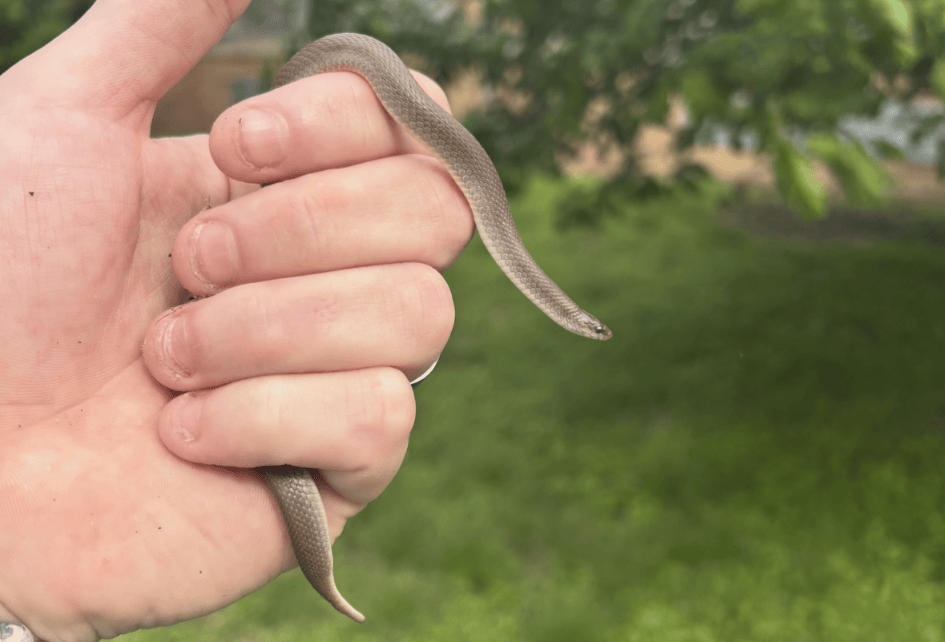
This is a rough earthsnake (Virginia striatula). He was minding his own business. I am not in the habit of manhandling wild animals, but in this case, I was compelled to do so in order to save him from the violent death a bunch of rowdy third-graders were about to visit upon him. I apologize for the state of my fingernails.
About a week later, I sojourned even further into the bleak depths of G/T Project land.
It’s about to get really dark…
About a week after the non-starter that was the biological census, I asked the office manager for the key to the supply closet. She obliged because she (wrongly) assumed I just needed pencils or something. I proceeded to purloin about five or six thousand notecards–they come in packs of a hundred. The kids were going to do an “engineering and architecture challenge.” Because I am theoretically a good teacher, I knew they would need an exemplar. Here it is:
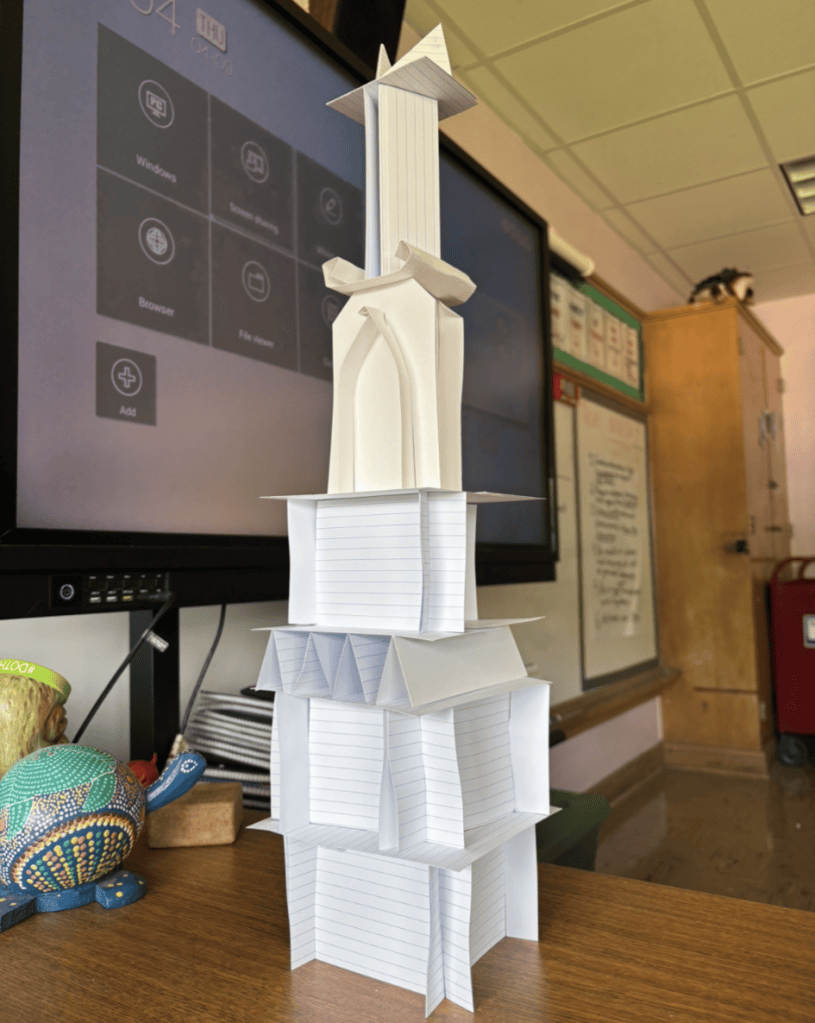
One of my fellow educators, who is also a tragic nerd, pointed out that I had essentially re-created Barad-dûr, seat of Sauron’s hideous power, out of 3x5s. Anyway… STEM!
I wish I could say that it stopped there, but, in short order, we were also trying our hands at paper airplane distance contests and artistic collage (I made a little speech about pop art, which I don’t think really landed):
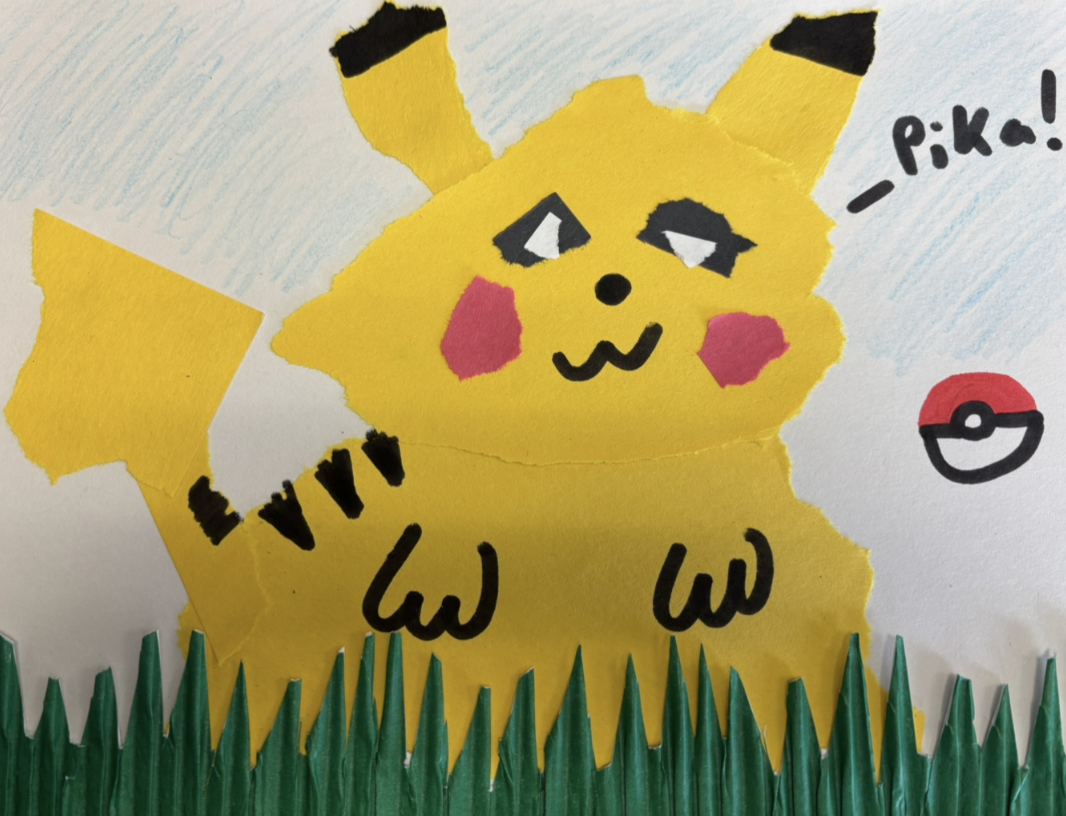
Another exemplar. Is there anything more satisfying than being a better artist than a first-grader?
Frankly, I was prepared to go even harder, but I refused to spend my own money on either spaghetti or marshmallows that I wouldn’t be eating, and a cardboard challenge was out of the question, because it turns out front office staff will notice when a bunch of the “for shred” boxes go missing. Records do actually need to get shredded, y’all, and there will be an all-call email about it.
I also had the notion to do popsicle stick bridges, and even constructed one myself (another exemplar!), but it turns out that popsicle sticks, for whatever reason, are weirdly expensive. One regular popsicle stick costs about six cents, if you’re wondering, and it adds up.
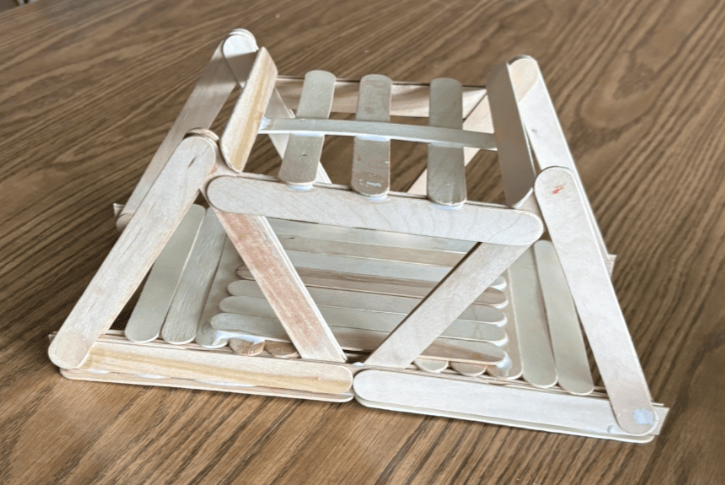
Not pictured: The Mothman
What did I learn from all of this? After all, the students were engaged and happy. Nobody revolted. Some products proved something interesting had happened in class. But as I said, we were doing these things because I was out of ideas and out of curriculum. By the end of the year, my carefully constructed plans had given way to whatever I could find that would keep a room full of bright children occupied. I was the villain now. I was the G/T Project Gentleman.
What held all these projects together? Nothing.
A gifted program cannot depend entirely, or at all, on an individual and indefatigable teacher maintaining an inexhaustible supply of clever activities. More importantly, a clown car full of projects is not the same thing as a curriculum. And it certainly isn’t gifted education, which has never suffered from a shortage of fun activities, many of which are dubiously worthwhile. But the problem is not that gifted students sometimes build towers out of whatever is lying around, throw airplanes, solve puzzles, or make collages. The problem comes when the activity itself becomes the curriculum.
“Was it fun?” is a reasonable question, but it cannot be our only question.
We also have to ask:
What did students learn? What kind of thinking did the activity require? How did it connect to what came before? Where might that learning take them next? Did students encounter an idea they could not immediately understand? Did they have to reconsider an assumption, defend a conclusion, or revise their work?
If we cannot answer those questions, we may have created an enjoyable experience, but we have not done either the necessary or sufficient work to call something “gifted education.”
Here’s the thing, though…
Was it chaotic? Yes. Did the kids learn very much? Not as much as I would have liked.
But, also, who cares?
For those last few weeks of school, we didn’t once pull out the laptops. While those kids were in my class, they didn’t ever stare, dead-eyed and slack-jawed at a screen, or get fed AI slop, or produce AI slop, or have to wait for a friendly digital robot to determine when it was time for their prescribed five-minute “brain break.” Were the collages we made, the towers we built, or the airplanes we threw down the hall high-quality learning experiences? Not in any measurable sense. But I can guarantee that the collages are on some grandma’s refrigerator, that the airplanes are in a shoebox full of other keepsakes, and that the little snake in the picture up there is something they’ll remember after I’m long dead. And that’s pretty special. Every single one of these projects is getting integrated into that new curriculum I was telling you about earlier. Pop Art Pikachu up there lends himself fairly well to a Depth and Complexity lesson about the Details icon, for instance.
I have been too harsh on the G/T Project Lady. She is not a villain. Nor am I. I’m glad that, as an adult, her spirit found a weird way of reaching out and helping me overcome the jadedness, to remember how joyful it is to actually hold something in your hand as opposed to reading about it on the internet.
Apologies to the snake, who is almost certainly traumatized.

